

We’re all often asked who our role models are. When I was asked this question on a friend’s fun podcast I gave an unfathomably horrible answer.
As evident by my flubbing, it’s hard for me to answer that question! I can talk about how much I love a certain product, business, song, book. I can even talk about how special the person must have been who created it. But I can’t name a role model.
It’s probably because had really disappointing experience meeting a hero of mine when I was a kid. I loved the book they wrote, and then when they were mean to me at a fan-meeting, I was devastated. It was hard to read their books after that! I recognize that my relationship with them was more like the relationship between a kid and their imaginary friend. I didn’t let them act like a real person. Nowadays, before I meet someone I really admire, I really try to separate my relationship with their work and my potential relationship with them as a human. I acknowledge that my relationship with their work is akin to having an imaginary friend. It allows me to recognize their humanity (famous people can get crabby at an annoying kid book signing) while preserving the part of myself evoked by the work.
The other hard part of having role models is impostor syndrome. Nobody who does amazing stuff, no matter how much of an "aw shucks” vibe they give off, can do that stuff without believing in themselves. I’ve found that the only way to keep believing in myself is to not spend too much time thinking about role models and comparisons. I try to stay so inspired to get work done that there isn't even time to be insecure about it, I just have to do it. I have to think about others’ work ( like great movies and books and yes, the music of You-Know-Who) or my work (like…writing this substack, startup stuff, my podcast and other bits and sundry!) I cannot think about people too much. This means I am extremely unprepared when the “role model” question comes up.
So, I’m still not sure about my answer to that question. I’d be curious what you’d say when asked who your role models are! But for now, the thing I focus on is telling myself, “Hey, stop looking outwards and look inwards. Comparison is the thief of joy. You can do it!” Cause you can!
And as a bonus (because I’m taking next week off from the newsletter!), here are 5 great things I read and consumed this week:
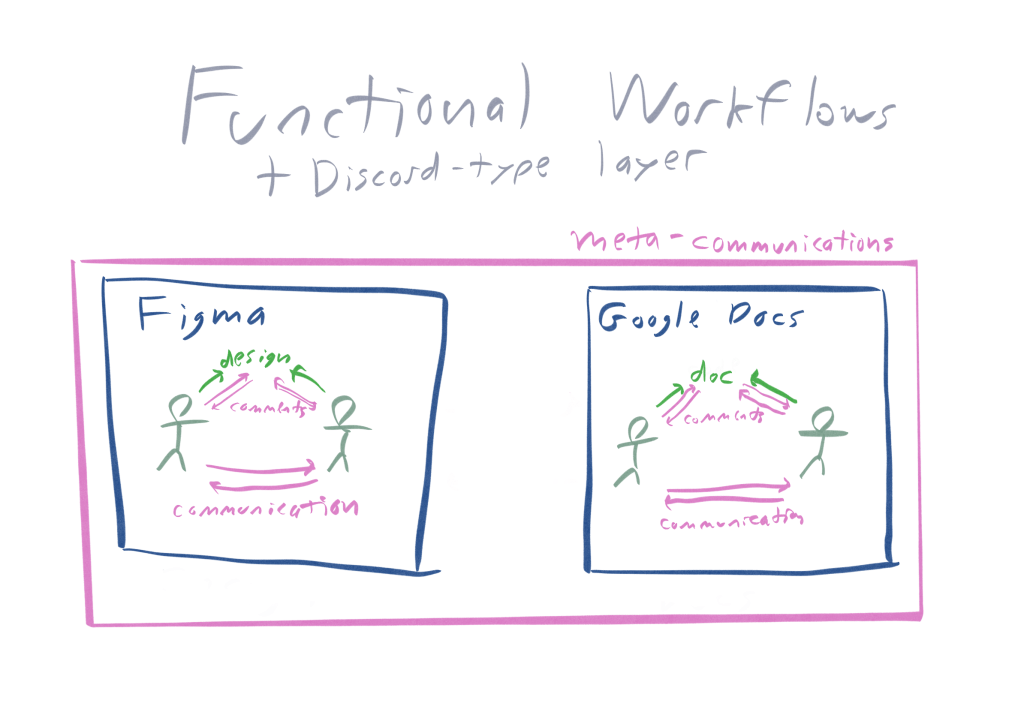
The Arc of Collaboration by Kevin Kwok: This piece about the “future of work and collaboration is Discord for Work, around functional workflows” is incredibly insightful. The image below really captures it.
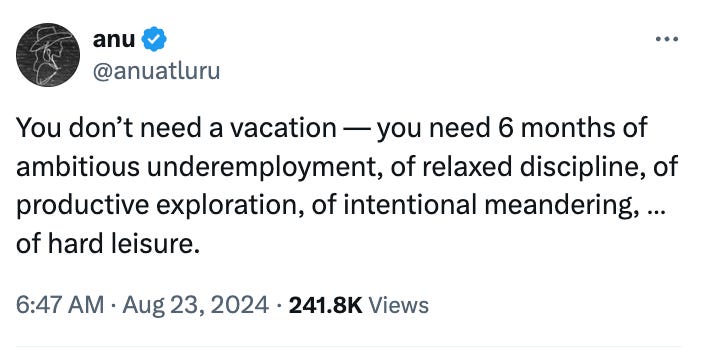
This tweet re-raised some thoughts I had about sabbaticals. I wrote a post about “why everyone is taking sabbaticals?!” a while ago, and I’m curious what you think of this idea. Is there a way to sabbatical well? When do people need a sabbatical versus a vacation? How do you supress the desire to grind and achieve during that time?
This missive from an AI conference, published in n+1 mag. I sent it to my vet sister because of the truly insane and dystopic conversation between a vet med bot (a real use case!) and a pet owner.
The CEO leaned an elbow on the podium. “I’ll tell you a story,” he said.
A woman wrote to VERA about her elderly dog, who was having diarrhea.
“Your dog is at the end of his life,” said VERA. “I recommend euthanasia.”
The woman was beside herself. She told VERA she wasn’t ready to say goodbye. Her dog was her only companion.
VERA knew the woman’s location. She sent a list of nearby clinics that could get the job done. Still, the woman was unconvinced. Euthanasia was so expensive. She’d never be able to afford it. VERA sent another list, this time of nearby shelters. “If you relinquish your dog to a shelter, they will euthanize him at no cost,” she said.
The woman did not respond. But some days later she sent VERA a long and effusive message. She had taken VERA’s advice and euthanized her dog. She wanted to thank VERA for the support during the most difficult moment of her life.
The CEO regarded us with satisfaction for his chatbot’s work: that, through a series of escalating tactics, it had convinced a woman to end her dog’s life, though she hadn’t wanted to at all. “The point of this story is that the woman forgot she was talking to a bot,” he said. “The experience was so human.”
If you haven’t seen Meter Command, I think it’s an excellent vision of the future of AI-powered software. The options of many mediums — a canvas, a dashboard, or a chat! The ability to DRAG DROP in an actually effective way! This is the IDE for the network engineer. It’s so cool. What else could this format be applied to?
Friend breakups: Friend breakups are so traumatic, but we don’t acknowledge their severity as something akin to romantic breakups. They simply fizzle away because of distance. I found this idea compelling — “unconditional positive regard” is beautiful.
A psychologist might call that “unconditional positive regard,” a phrase popularized by the therapist and author Carl Rogers in the 1950s: accepting someone for who they are, and choosing to see the best in them. In her story for The Atlantic on midlife friendship, Jennifer Senior quoted a researcher who invoked the phrase to describe friendship at its best. It’s a lovely sentiment. It also suggests that when a close friendship ends, it means she saw you at your worst, and decided she hated it.